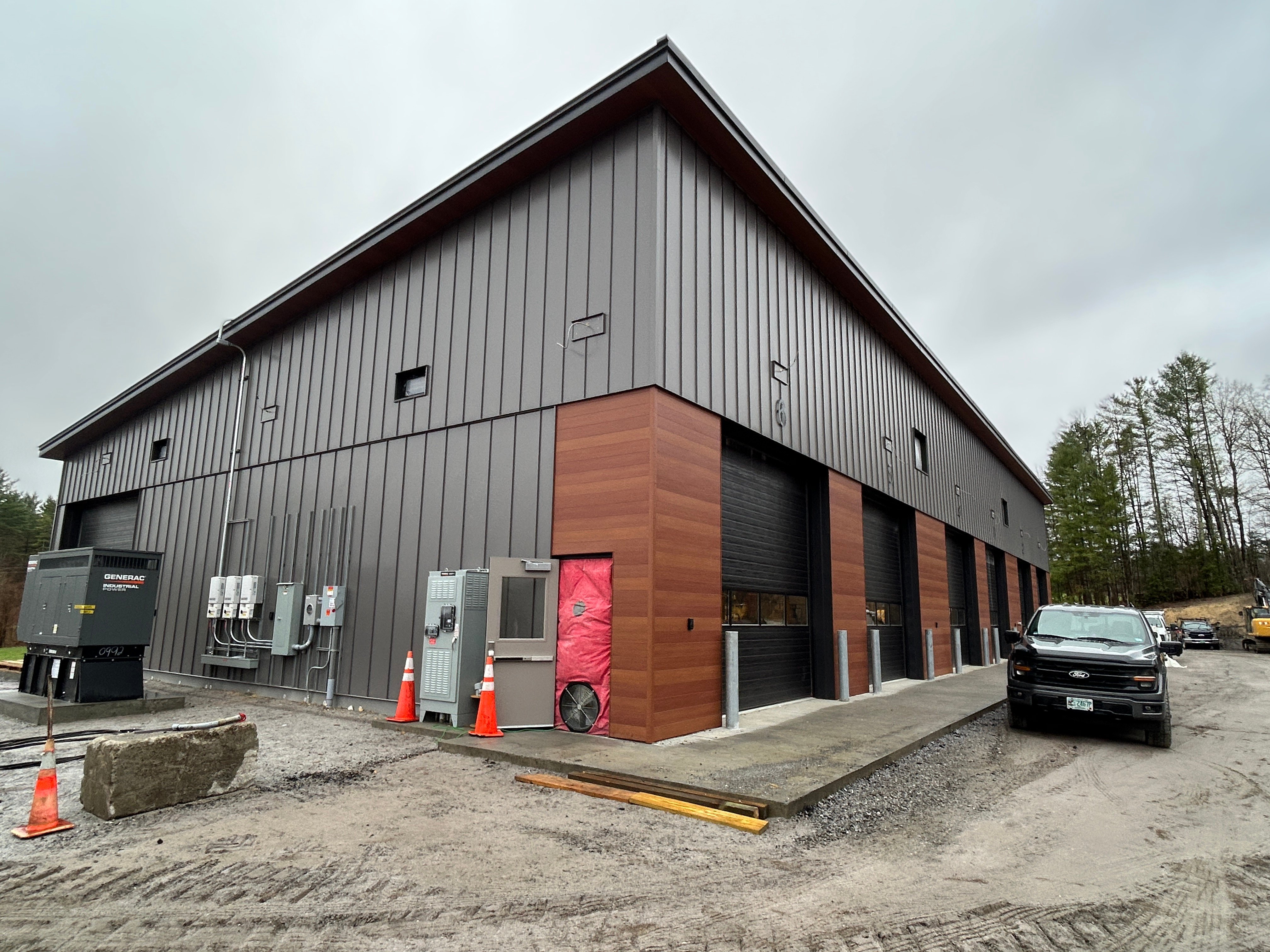
Katie Mason Promoted to Senior Associate
Katie has been an integral part of the Cx Associates team since 2012, growing from Engineering...
Cx Associates performs ASTM E779 field testing. We've performed building enclosure commissioning and air barrier field testing on commercial, industrial, institutional, multifamily, and residential projects across Vermont and the Northeast. Our team includes experts with deep familiarity in building code and enclosure standards.
Total air leakage rate of a building at standardized pressure differentials
Commercial, institutional, multifamily, and residential buildings of any size
Both new construction compliance testing and existing building diagnostics
IECC, ASHRAE 90.1, LEED, Passive House, DOE Zero Energy Ready, state energy codes, project specifications
Quantitative — produces a measured air leakage rate (cfm50, cfm75, EqLA, or ELA) and air leakage metric for comparison to code or specification limits
Ready to schedule building enclosure testing? Contact us to discuss your project timeline and enclosure scope.
ASTM E779 is the standard test method for measuring the total air leakage rate of a building using fan pressurization — commonly known as blower door testing. The test involves temporarily installing a calibrated fan system in an exterior opening (typically a door), sealing all intentional openings (mechanical system inlets and exhausts, fireplaces, etc.), and then pressurizing or depressurizing the building to a series of pressure differentials ranging from 10 to 60 Pascals. At each pressure step, the fan flow rate required to maintain the pressure is measured. These data points are used to calculate the air leakage rate at a standard reference pressure — most commonly 50 Pascals (cfm50 or ACH50).
The E779 procedure uses a multi-point test with both pressurization and depressurization to characterize the building's leakage curve and produce a more accurate result than a single-point test. Results can be expressed in multiple units depending on the applicable specification: cfm50 (cubic feet per minute at 50 Pa), ACH50 (air changes per hour at 50 Pa), EqLA (equivalent leakage area at 4 Pa), or ELA (effective leakage area at 10 Pa).
Commercial and institutional buildings — schools, healthcare, offices, government facilities
Multifamily residential buildings — apartment buildings, condominiums, mixed-use
Single-family residential (though ASTM E1827 is more commonly used for residential applications)
New construction energy code compliance verification per IECC and ASHRAE 90.1
Building enclosure commissioning — verifying that the air barrier system meets design intent
Existing building diagnostics — establishing a baseline for energy retrofit planning
Certification programs requiring documented air leakage performance
Air leakage is invisible, difficult to attribute to any single trade, and almost impossible to assess accurately without measurement. A building can have a fully specified and inspected air barrier system and still leak far more air than intended — because air infiltration is the cumulative result of hundreds of small decisions made by multiple trades across the entire construction sequence. ASTM E779 blower door testing converts that complexity into a single, objective number. It does not matter how many inspections were performed or how many submittals were approved — the fan pressurization test measures what was actually built, not what was specified.
As commercial energy codes have tightened, the stakes around that number have risen. ASHRAE 90.1-2019 and later editions include mandatory air leakage limits for commercial buildings that must be verified by testing — not by documentation review. In Vermont and the Northeast, where heating loads dominate and the energy cost of air infiltration is substantial, the difference between a building that tests at 0.20 cfm75/ft² and one that tests at 0.45 cfm75/ft² represents a meaningful, lasting difference in operating cost and occupant comfort. When a building falls short of its target, E779 data also supports efficient remediation — by isolating zones and temporarily sealing suspect areas, the team can narrow down where leakage is concentrated before deploying diagnostic tools like ASTM E1186 to find specific deficiencies.

These standards are commonly specified alongside or in place of ASTM E779 depending on project scope. Cx Associates performs all of the following:
Single-point blower door test using an orifice blower door (simplified residential method)
Air leakage rate test for large or multizone buildings
Air leakage site detection (qualitative; used to locate leaks identified by E779)
Military building blower door testing requirements
International standard for air permeability testing (the international counterpart to E779)
Katie has been an integral part of the Cx Associates team since 2012, growing from Engineering...